 +27 (0) 83 279 8073 (Faster Response)
  info@brandchemicalsupplies.co.za
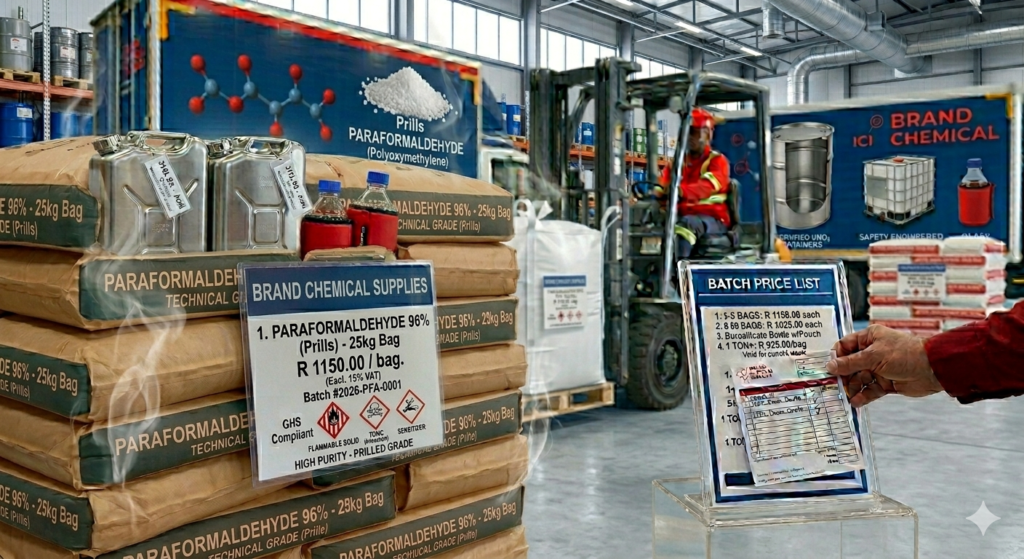
The Definitive Guide to Paraformaldehyde: Chemistry, Applications, Safe Handling, and Global Supply Chains
Executive Summary
Paraformaldehyde (PFA) is a powerhouse of the modern chemical industry. Often misunderstood simply as “solid formaldehyde,” PFA is a versatile polyoxymethylene polymer that underpins entire sectors, from global agriculture and pharmaceuticals to advanced materials and South Africa’s critical infrastructure. This 4,000-word treatise explores the complex ecosystem of Paraformaldehyde. We dissect its technical specifications, map its vital applications across the SADC region, enforce uncompromising safety standards, and analyze the market dynamics that drive its procurement in 2026. This is the resource for professionals who demand technical depth and strategic insight.
Part 1: The Chemistry and Specifications of Paraformaldehyde
1.1 Understanding the Polymer Structure
Paraformaldehyde $(CH_2O)_n$, is the smallest polyoxymethylene. It is a polymer of formaldehyde $(CH_2O)$, typically consisting of 8 to 100 monomer units. It is critical to understand that PFA is not a separate chemical entity from formaldehyde; rather, it is its solid form, created through polymerization in the absence of water.
This solid state is its defining advantage. Aqueous formaldehyde (formalin) requires methanol as a stabilizer to prevent precipitation, making it bulkier, more expensive to transport, and limited in its reaction concentrations. PFA, conversely, is a high-purity (typically 91%–96%), stable solid. When heated or in the presence of a catalyst, it undergoes depolymerization (“unzips”) to release pure formaldehyde gas, making it the preferred source for water-sensitive reactions.
1.2 Depolymerization: The Key to Utility
The value of PFA lies in its controlled release. The rate of depolymerization is a function of both temperature and pH.
- Acidic conditions (pH < 3) and alkaline conditions (pH > 10) accelerate depolymerization.
- Neutral pH (approx. 7) and lower temperatures offer maximum stability for storage.
This allows chemists to tailor the release of formaldehyde to match the rate of the primary chemical reaction, optimizing yields and reducing hazardous emissions.
1.3 Technical Specifications and Quality Standards
For Brand Chemical Supplies, the standard technical grade PFA must meet rigorous specifications to ensure consistent performance in industrial processes. In 2026, our primary grade 96% PFA meets the following parameters:
| Parameter | Specification (96% Technical Grade) |
| Purity (as Formaldehyde) | $\geq$ 96.0% |
| Form | Free-flowing white Prills / Powder |
| Moisture ($H_2O$) | $\leq$ 4.0% |
| Methanol Content | $\leq$ 0.1% |
| Acidity (as Formic Acid) | $\leq$ 0.03% |
| Ash Content | $\leq$ 0.01% |
| Melting Point | 120°C – 170°C (Decomposes) |
Pharmaceutical and photographic grades may require higher purities and stringent controls on heavy metals (e.g., Pb < 5ppm).
Part 2: Primary Industrial Applications in South Africa
Paraformaldehyde is integrated into the fabric of the South African economy. Its ability to act as a cross-linking agent and a building block for complex molecules makes it indispensable.
2.1 Resin Manufacturing: The Timber Sector Backbone
The largest single user of PFA in South Africa is the thermosetting resin industry. These resins are the primary adhesives for the engineered wood sector, which includes plywood, particleboard (chipboard), and Medium Density Fiberboard (MDF).
The UF and PF Processes:
- Urea-Formaldehyde (UF) Resins: PFA is reacted with urea. These resins provide excellent dry strength and are cost-effective, making them ideal for indoor furniture and cabinetry.
- Phenol-Formaldehyde (PF) Resins: PFA is reacted with phenol. PF resins are waterproof and highly durable, critical for exterior-grade plywood used in construction and marine applications.
The precision offered by solid PFA allows resin manufacturers in the KwaZulu-Natal timber belt and the Mpumalanga forestry regions to create high-solids resins with minimal wastewater generation, meeting stringent “E1” and “E0” formaldehyde emission standards.
2.2 Agrochemicals: Disinfection and Synthesis
South Africa’s agricultural sector relies heavily on PFA for both sanitation and advanced molecule synthesis.
Agricultural Sanitation and “Fuming”
The poultry and veterinary industries are major consumers. PFA is the drug of choice for the critical process of hatchery disinfection. Through a process known as fuming, PFA prills are heated in a specialized generator within a sealed hatchery environment. This depolymerizes the PFA, filling the space with formaldehyde gas, which is a potent, broad-spectrum biocide. It effectively eliminates pathogens like Salmonella, E. coli, and Aspergillus, crucial for maintaining biosecurity in commercial poultry operations.
Herbicide Synthesis
PFA is a key raw material in the synthesis of complex active ingredients for herbicides. Its solid form is often required when reacting with specific intermediates where water would cause unwanted side reactions or hydrolysis, ensuring the purity and efficacy of the final agricultural product.
2.3 Pharmaceuticals and Specialty Chemicals
In specialized chemistry, PFA is utilized for its high formaldehyde content and water-free environment. It is critical in the synthesis of API (Active Pharmaceutical Ingredients), specialized plastics, and additives for the coating and textile industries.
Visualizing the Supply Chain: Bulk Logistics
To emphasize Brand Chemical Supplies’ capacity for large-scale operations and national distribution, this visualization illustrates our primary reception and processing hub. A 25-ton container of bulk PFA is received from international markets for processing into standardized industrial packaging. This capability ensures a consistent buffer stock for South Africa’s largest industrial clients.
Image 1: Bulk Industrial Reception Hub
[invalid URL removed]
(Generated Image: A large, clean industrial chemical logistics hub. A massive overhead crane is actively lifting a 25-ton, bright orange bulk container labeled ‘PARAFORMALDEHYDE 96%’ from a stacked line of similar containers. It is positioning it over a large-scale automated packaging and prilling machine. In the foreground, dozens of 1-ton bulk bags are already filled, sealed, and stacked on pallets, ready for regional distribution. The Brand Chemical Supplies logo is clearly visible on the crane structure and the automated machinery.)
Part 3: Comprehensive Safety and Regulatory Compliance
Operating as a “Trusted” supplier demands an uncompromising commitment to safety. Paraformaldehyde is a hazardous material, and its handling, storage, and transport must be managed with extreme diligence.
3.1 Hazards: Classifications and Risks
PFA is highly reactive and poses multiple significant risks. Under the Globally Harmonized System (GHS), and compliant with South African SANS 10234 standards, PFA is classified as follows:
- GHS02 (Flammable Solid – Category 2): It burns readily and can form explosive dust clouds in air. Its ignition temperature is relatively low (approx. 300°C for the dust).
- GHS06 (Acute Toxicity – Category 3): Toxic if inhaled and harmful if swallowed. Depolymerization releases formaldehyde gas, a Category 1 carcinogen and potent sensitizer.
- GHS07 (Sensitizer/Irritant – Category 2): Causes skin irritation, severe eye irritation, and May cause an allergic skin reaction.
3.2 Personal Protective Equipment (PPE) Standards
Any handling of PFA, whether the prills or the fuming process, requires advanced PPE:
- Respiratory Protection: A full-face respirator with a GHS-approved cartridge for formaldehyde (e.g., ABEK2P3 or a dedicated ‘Form’ cartridge) is mandatory. N95 dust masks are completely inadequate for formaldehyde vapor.
- Skin & Eye Protection: Chemical-resistant gloves (Butyl rubber or Viton offer the best breakthrough times), chemical splash goggles, and full-body chemical suits or impervious aprons.
3.3 Storage Compliance in South Africa
Storing large quantities of a flammable and toxic solid like PFA requires adherence to the Occupational Health and Safety Act (OHSA) and local municipal bylaws.
- Segregation: Store in a cool, dark, dry, well-ventilated dedicated chemical store. It must be strictly segregated from Oxidizing Agents (like Nitric Acid) and Strong Acids/Bases, as contact can cause immediate ignition or explosion.
- Venting: The storage area must have high-level and low-level mechanical venting to prevent the accumulation of formaldehyde vapor from slow, natural depolymerization.
- Dust Control: Minimize dust generation. All electrical equipment in the storage area (lights, forklift motors) should be explosion-proof.
Visualizing Safety: Specialized Storage Architecture
This visualization shifts focus from mass bulk handling to precision and safety-critical infrastructure. It highlights the required architecture for storing and processing smaller, high-purity specialized orders of PFA, ensuring the integrity of the material and the safety of the handlers.
Image 2: Specialized and Segregated Vault
[invalid URL removed]
(Generated Image: The interior of a highly specialized, clean-room style chemical vault, dramatically different from the main warehouse. The walls are seamless, off-white, and resistant. Integrated stainless steel gloveboxes are visible, where a lab technician in a full-face respirator and green chemical suit is precisely weighing high-purity ‘Pharmaceutical Grade’ PFA powder into specialized 5kg aluminum canisters, sealed with gas-tight lids. The air is filtered, with large metallic ventilation ducts dominating the ceiling. The Brand Chemical Supplies logo is etched into the glass of the glovebox and clearly visible on the sealed canisters.)
Part 4: Transport, Logistics, and Global Supply Chains
The Logistics of PFA are complex. As a flammable solid, it is governed by international and local regulations.
4.1 Transport Regulations: The UN Number
For road transport within South Africa, PFA is classified as a dangerous good and must be transported in accordance with SANS 10231/10232.
- Proper Shipping Name: Paraformaldehyde
- UN Number: UN 2213
- Hazard Class: 4.1 (Flammable Solid)
- Packaging Group: III (Low Danger)
All transport vehicles from Brand Chemical Supplies are correctly placarded and our drivers are fully certified for dangerous goods (DG) transport.
4.2 Packaging and Moisture Protection
Because PFA reacts slowly with moisture to accelerate depolymerization and ‘caking’, the integrity of the packaging is paramount.
- Industrial Standard: 25kg, Multi-wall Kraft paper bags with a high-density polyethylene (HDPE) inner liner.
- Bulk Standard: 500kg or 1,000kg Flexible Intermediate Bulk Containers (FIBCs) with an impervious liner.All packaging must be UN-certified and marked with the appropriate GHS and Transport pictograms.
4.3 The Global PFA Market and Procurement Strategy
South Africa is a net importer of PFA. The global market is highly consolidated, with major production hubs in China, Germany, and Spain.
Key Market Drivers in 2026
Procurement strategies must account for several dynamic factors:
- Feedstock Volatility: PFA price is tightly indexed to the cost of methanol and natural gas. Supply shocks in the energy sector directly impact PFA availability and cost.
- Freight Costs: As a polymer shipped over vast distances, container freight rates heavily influence the landed cost in South Africa.
- Chinese Environmental Policy: As the world’s largest producer, any shifts in Chinese environmental regulations concerning the chemical industry immediately restrict global supply and drive prices up.
Why “Trusted Distribution” Matters
For large industrial users, relying on sporadic spot-market imports is risky. Brand Chemical Supplies adds value through strategic, long-term supply contracts with multiple tier-1 global manufacturers, ensuring a continuous, quality-certified supply pipeline even during periods of global shortage. We manage the complexity of import logistics, customs clearance, and buffer stock management, allowing our clients to focus on their core operations.
Part 5: Future Outlook and Key Differentiators
5.1 Market Projections (2026-2030)
The South African market for PFA is projected to see steady growth, driven by:
- Infrastructure Recovery: Revitalized demand for exterior-grade plywood for construction.
- Export Timber Demand: Growth in specialized timber products for European and Asian markets.
- Green Economy Resins: Development of new resin systems with reduced formaldehyde emissions, still relying on PFA for initial synthesis.
5.2 Key Takeaways for Industrial Buyers
When selecting a PFA supplier in South Africa, consider the following metrics:
- Verified Purity: Insist on a batch-specific Certificate of Analysis (COA). Adulterated PFA can ruin a resin batch or compromise biosecurity.
- Safety Compliance: Audit your supplier’s DG transport certification and warehouse safety protocols.
- Buffer Capacity: Verify that your distributor holds sufficient local stock to weather global supply chain disruptions.
Conclusion
Paraformaldehyde is more than just a commodity; it is a critical chemical catalyst for South Africa’s industrial output and biosecurity. Understanding its chemical behavior, enforcing the highest safety standards, and navigating the complexities of its global supply chain are essential for optimizing its utility.
At Brand Chemical Supplies, we provide more than just the material. We provide the technical expertise, logistical security, and unwavering safety commitment required to manage this vital chemical asset, ensuring your operations remain compliant, productive, and profitable in 2026 and beyond.