 +27 (0) 83 279 8073 (Faster Response)
  info@brandchemicalsupplies.co.za
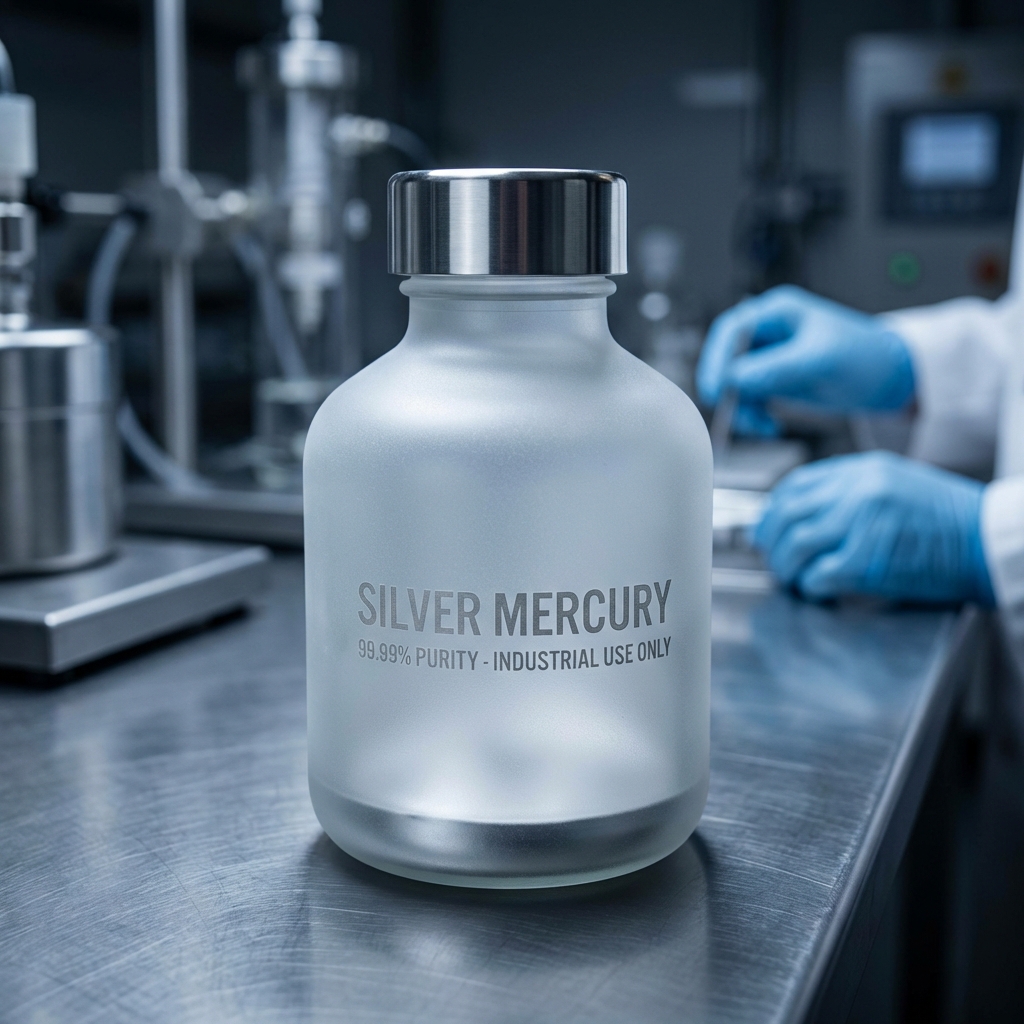
Mercury’s Non-Wetting Behavior: Why Mercury Does Not Wet Glass or Most Plastics
Mercury is a unique element with a set of remarkable physical and chemical properties. One of its most intriguing characteristics is its inability to wet glass or most plastics. This property has significant practical implications in science, industry, and technology. We’ll explore what it means for a liquid to “wet” a surface, why mercury resists wetting glass and plastics, the science behind this phenomenon, and its benefits and uses.
What Does “Wetting” Mean?
Wetting is a term used in surface science to describe how a liquid interacts with a solid surface. When a liquid wets a surface, it spreads out to form a thin, even layer, adhering closely to the material. Water, for example, readily wets clean glass, spreading into a continuous film. Wetting is essential in processes like painting, coating, and adhesion.
If a liquid does not wet a surface, it forms droplets or beads instead of spreading out. The degree of wetting is determined by the balance between adhesive forces (between the liquid and the solid) and cohesive forces (within the liquid itself).
Mercury’s Distinctive Behavior
Mercury, symbolized as Hg, is the only metal that is liquid at room temperature. When poured onto glass or most plastics, mercury does not spread out or adhere to the surface. Instead, it forms spherical droplets that roll easily across the surface. This is a clear sign of poor wetting.
This behavior is due to two key factors: strong cohesive forces within mercury and weak adhesive forces between mercury and non-metallic surfaces such as glass and plastic. The surface tension of mercury is much higher than that of water, causing it to resist breaking apart and spreading.
The Science Behind Mercury’s Non-Wetting Properties
Mercury’s non-wetting property can be explained by surface tension and interfacial energy. Surface tension is the force that causes the surface of a liquid to contract, making it behave like a stretched elastic membrane. Mercury has one of the highest surface tensions of any liquid, which means its atoms are strongly attracted to each other.
When mercury comes into contact with glass or most plastics, the attraction between mercury atoms (cohesive forces) is much stronger than the attraction between mercury and the surface (adhesive forces). As a result, mercury minimizes its contact with these materials, forming rounded beads.
The contact angle—the angle at which a liquid interface meets a solid surface—of mercury on glass is very high, often exceeding 140 degrees. A high contact angle indicates poor wetting, as seen with mercury on glass or plastic.
Practical Implications and Uses
Mercury’s inability to wet glass and plastics has important practical applications:
- Mercury Thermometers: The non-wetting property ensures that mercury columns in thermometers remain clean and precise. Mercury does not cling to the glass, so readings are accurate and repeatable.
- Barometers and Scientific Instruments: In barometers and manometers, mercury’s non-wetting behavior prevents it from sticking to glass tubes, maintaining measurement accuracy.
- Electrical Switches: Mercury switches often use glass or plastic enclosures. The non-wetting nature prevents unwanted electrical paths and maintains switch reliability.
- Laboratory Use: Mercury is easy to handle and clean up in laboratories when spilled on glass or plastic surfaces, as it does not spread or adhere.
Benefits of Mercury’s Non-Wetting Property
- Accuracy: Prevents mercury from sticking to measurement devices, ensuring reliable readings.
- Easy Handling: Spilled mercury can be collected easily from glass or plastic surfaces.
- Reduced Contamination: Limits the risk of mercury residue affecting future measurements.
- Durability: Scientific instruments last longer as mercury does not corrode or degrade glass and most plastics.
Mercury and Surface Modification
While mercury does not wet clean glass or most plastics, surface modifications or contaminants can change this behavior. For example, if glass is coated with a metal or contaminated with certain chemicals, mercury may begin to wet the surface. Understanding this interaction is important in both scientific research and industrial processes.
Environmental and Health Considerations
Despite its useful properties, mercury is highly toxic. Care must be taken to use and dispose of mercury safely. Non-wetting surfaces like glass and plastic help minimize mercury’s spread in the event of a spill, but proper cleanup and disposal are still essential to prevent environmental contamination and health risks.
Conclusion
Mercury’s inability to wet glass or most plastics is a distinctive and beneficial property that underpins its use in many scientific and industrial instruments. This behavior results from mercury’s high surface tension and strong cohesive forces, making it easy to handle and ensuring accuracy in measurement devices. However, due to its toxicity, the use of mercury is declining, and alternatives are being developed. Understanding mercury’s non-wetting property remains important for safe handling and for appreciating its historical role in scientific advancement.
mercury non-wetting, mercury and glass, mercury on plastic, surface tension of mercury, mercury thermometers, mercury behavior, mercury science, mercury properties, mercury applications, mercury safety, mercury toxicity